Spotify
1 Week 2026
A design strategy exploration into how Spotify can evolve from passive streaming into a participatory audio platform. The project investigates how shared, playful experiences can strengthen emotional connection and platform engagement.
Design Strategy
Platform Innovation
Spotify
1 Week 2026
A design strategy exploration into how Spotify can evolve from passive streaming into a participatory audio platform. The project investigates how shared, playful experiences can strengthen emotional connection and platform engagement.
Design Strategy
Platform Innovation
context
Spotify’s Innovation Team is exploring new ideas of any scale in response to one of the following focus areas: listener discovery and engagement; creator tools and; new audio-based experiences beyond the app.
Strategic challenge
How might Spotify expand beyond personalized discovery to become the primary platform for shared musical experiences?
outcome
A speculative product direction generated from a 100-ideas sprint and refined into a focused feature prototype.
Case Study Overview
Context & Problem
Core Tension
Research & Insights
Divergent Exploration
Synthesis & Insight
Implementation (What We Built)
Why This Works
Future Extensions
Divergent Exploration
Expanding the Possibility Space
We began the project by intentionally widening the solution space. Rather than jumping directly to features, our goal was to explore how Spotify could evolve across multiple dimensions of its ecosystem from listener engagement to creator participation to entirely new audio-based experiences. This phase prioritized volume, variation, and speculative thinking to surface unexpected opportunity areas before narrowing focus.
Rapid Ideation Sprint
To generate momentum quickly, we conducted a structured ideation sprint, producing over 100 concepts within a compressed timeframe. The objective was to prioritize quantity over polish, allowing unconventional and speculative ideas to surface without early filtering.
Lateral Expansion Techniques
Breaking Conventional Boundaries
We used lateral thinking prompts to challenge existing assumptions about streaming. Instead of asking “What feature should Spotify add?”, we reframed prompts such as:
What if Spotify wasn’t just for listening?
What if music behaved like a game?
What if listeners became participants?
What would music interaction look like without a screen?
These reframes allowed us to move beyond incremental improvements and consider platform transformation.
AI as an Ideation Amplifie
To stretch beyond predictable thinking patterns, we incorporated AI-assisted concept generation. AI was used not to replace creativity but to accelerate divergence and introduce unexpected combinations of behaviors, formats, and interaction models.
Capturing and Visualizing Exploration
All concepts were documented and visually mapped to identify emerging directions. Rather than evaluating ideas individually, we examined them collectively to observe recurring themes and behavioral signals.


Synthesis & Insight
As ideas were clustered and evaluated, several recurring behavioral themes surfaced across categories.
Discovery Was Not the Primary Gap
While many concepts enhanced personalization, they did little to address the emotional isolation of solo listening.
Participation Generated Energy
Ideas centered around action — playing, guessing, singing, remixing — consistently felt more socially compelling than ideas centered around passive access.
Music Culture Is Ritualistic and Interactive
From trivia nights to karaoke to jam circles, music has historically functioned as a participatory activity. Streaming removed the interaction layer but not the desire for it.
Low-Friction Social Moments Outperformed Heavy Social Infrastructure
Concepts that enabled quick, spontaneous interaction resonated more than those requiring long-term commitment or coordination.
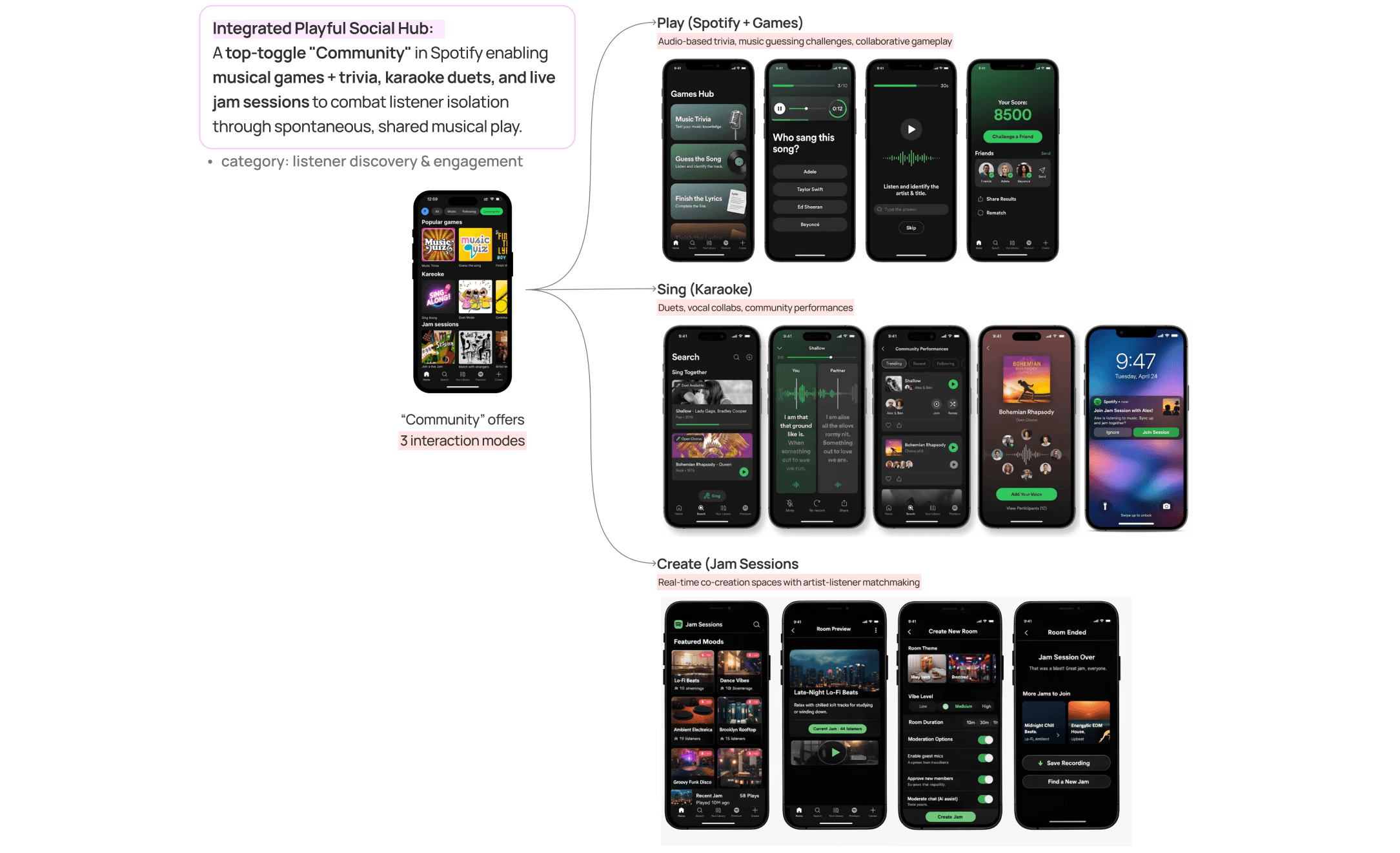
Integrated Playful Social Hub:
A top-toggle "Community" in Spotify enabling musical games + trivia, karaoke duets, and live jam sessions to combat listener isolation through spontaneous, shared musical play.
Play (Spotify + Games)
Audio-based trivia, music guessing challenges
Sing (Karaoke)
Duets, vocal collabs
Create (Jam Sessions)
Real-time co-creation spaces
category: listener discovery & engagement
Implementation
Interaction > Proximity
Reposition Spotify as a Participatory Audio Platform
Rather than optimizing features, the goal was to reframe Spotify’s role in users’ lives shifting from passive listening utility to participatory cultural platform.
01
Play builds connection through:
Shared challenge (competition creates energy) Collaboration (guessing together, team modes) Momentum (quick, repeatable interactions)
02
Sing builds connection through:
Vulnerability (low-stakes expression) Social validation (duets, reactions) Identity expression (song choice as self-expression)
03
Create builds connection through:
Co-ownership (building something together) Musical dialogue (call-and-response, layering) Serendipity (unexpected creative chemistry)
Why it works
Methodology
Inspired by human-centered design principles, the process moved from broad exploration to focused concept direction balancing desirability, viability, and feasibility.
Desirability (Human Fit)
Aligns with existing listening behavior.
Drop-in / drop-out participation (low commitment) Personalization powered by listening data Flexible modes for different comfort levels
Viability (Business Impact)
Engagement Lift
Interactive sessions increase time spent More touchpoints strengthen habit loops
Revenue Expansion
Premium modes Sponsored challenges Creator-led monetization
Competitive Positioning
Differentiates from consumption-first competitors Establishes defensible social audio positioning
Feasibility (Operational Reality)
Existing Infrastructure
Group Session → real-time sync foundation Lyrics API → karaoke base Audio fingerprinting → trivia logic Open API → extensibility
Proven Market Signals
SMULE proves karaoke scale SongPop proves audio trivia viability BandLab proves collaborative audio is feasible
Conclusion: Future Suggestion
The core insight is that users don’t build connection by simply hearing the same content; they build connection by doing something together. By shifting from “listen together” to “play together,” Spotify can evolve from a streaming platform into a participatory music ecosystem, increasing engagement, retention, and emotional brand connection.
To deepen Gen Z community-driven engagement, Spotify can expand beyond the screen into immersive and hybrid experiences:
Spotify Experience Lands (Physical + Digital Immersion)
Create spaces where music becomes an environment rather than background audio— encouraging emotional bonding, identity expression, and social discovery.
Silent Disco Powered by Spotify:
Silent discos represent the ideal balance between personal and collective listening. By enabling synchronized but individualized listening experiences, Spotify can solve real-world constraints like noise regulations and public space limitations while creating visually and socially engaging community moments.
Spotify
1 Week 2026
A design strategy exploration into how Spotify can evolve from passive streaming into a participatory audio platform. The project investigates how shared, playful experiences can strengthen emotional connection and platform engagement.
Design Strategy
Platform Innovation
context
Spotify’s Innovation Team is exploring new ideas of any scale in response to one of the following focus areas: listener discovery and engagement; creator tools and monetization;
new audio-based experiences beyond the app.
Strategic challenge
How might Spotify expand beyond personalized discovery to become the primary platform for shared musical experiences?
outcome
A speculative product direction generated from a 100-ideas sprint and refined into a focused feature prototype.
Case Study Overview
Context & Problem
Core Tension
Research & Insights
Divergent Exploration
Synthesis & Insight
Implementation (What We Built)
Why This Works
Future Extensions
Core Tension
Music is inherently social, yet streaming is designed for solitude.
Spotify has mastered personalized discovery, creating deeply individual listening journeys. However, shared musical moments increasingly happen outside the platform on messaging apps, social media, or live events. The tension lies in expanding Spotify’s role from a personal utility to a participatory space without compromising its audio-first identity.
A listener who feels isolated or bored with solo listening needs playful, low-pressure ways to experience music with others but Spotify’s built-in interactions remain limited.
Divergent Exploration
Expanding the Possibility Space
We began the project by intentionally widening the solution space. Rather than jumping directly to features, our goal was to explore how Spotify could evolve across multiple dimensions of its ecosystem from listener engagement to creator participation to entirely new audio-based experiences. This phase prioritized volume, variation, and speculative thinking to surface unexpected opportunity areas before narrowing focus.
Rapid Ideation Sprint
To generate momentum quickly, we conducted a structured ideation sprint, producing over 100 concepts within a compressed timeframe. The objective was to prioritize quantity over polish, allowing unconventional and speculative ideas to surface without early filtering.
Lateral Expansion Techniques
Breaking Conventional Boundaries
We used lateral thinking prompts to challenge existing assumptions about streaming. Instead of asking “What feature should Spotify add?”, we reframed prompts such as:
What if Spotify wasn’t just for listening?
What if music behaved like a game?
What if listeners became participants?
What would music interaction look like without a screen?
These reframes allowed us to move beyond incremental improvements and consider platform transformation.
AI as an Ideation Amplifie
To stretch beyond predictable thinking patterns, we incorporated AI-assisted concept generation. AI was used not to replace creativity but to accelerate divergence and introduce unexpected combinations of behaviors, formats, and interaction models.
Capturing and Visualizing Exploration
All concepts were documented and visually mapped to identify emerging directions. Rather than evaluating ideas individually, we examined them collectively to observe recurring themes and behavioral signals.
Synthesis & Insight
As ideas were clustered and evaluated, several recurring behavioral themes surfaced across categories.
Discovery Was Not the Primary Gap
While many concepts enhanced personalization, they did little to address the emotional isolation of solo listening.
Participation Generated Energy
Ideas centered around action — playing, guessing, singing, remixing — consistently felt more socially compelling than ideas centered around passive access.
Music Culture Is Ritualistic and Interactive
From trivia nights to karaoke to jam circles, music has historically functioned as a participatory activity. Streaming removed the interaction layer but not the desire for it.
Low-Friction Social Moments Outperformed Heavy Social Infrastructure
Concepts that enabled quick, spontaneous interaction resonated more than those requiring long-term commitment or coordination.
Integrated Playful Social Hub:
A top-toggle "Community" in Spotify enabling musical games + trivia, karaoke duets, and live jam sessions to combat listener isolation through spontaneous, shared musical play.
Play (Spotify + Games)
Audio-based trivia, music guessing challenges
Sing (Karaoke)
Duets, vocal collabs
Create (Jam Sessions)
Real-time co-creation spaces
category: listener discovery & engagement
Implementation
Interaction > Proximity
Reposition Spotify as a Participatory Audio Platform
Rather than optimizing features, the goal was to reframe Spotify’s role in users’ lives shifting from passive listening utility to participatory cultural platform.
01
Play builds connection through:
Shared challenge (competition creates energy) Collaboration (guessing together, team modes) Momentum (quick, repeatable interactions)
02
Sing builds connection through:
Vulnerability (low-stakes expression) Social validation (duets, reactions) Identity expression (song choice as self-expression)
03
Create builds connection through:
Co-ownership (building something together) Musical dialogue (call-and-response, layering) Serendipity (unexpected creative chemistry)
Why it works
©2026
Methodology
Inspired by human-centered design principles, the process moved from broad exploration to focused concept direction balancing desirability, viability, and feasibility.
Desirability (Human Fit)
Aligns with existing listening behavior.
Drop-in / drop-out participation (low commitment) Personalization powered by listening data Flexible modes for different comfort levels
Viability (Business Impact)
Engagement Lift
Interactive sessions increase time spent More touchpoints strengthen habit loops
Revenue Expansion
Premium modes Sponsored challenges Creator-led monetization
Competitive Positioning
Differentiates from consumption-first competitors Establishes defensible social audio positioning
Feasibility (Operational Reality)
Existing Infrastructure
Group Session → real-time sync foundation Lyrics API → karaoke base Audio fingerprinting → trivia logic Open API → extensibility
Proven Market Signals
SMULE proves karaoke scale SongPop proves audio trivia viability BandLab proves collaborative audio is feasible
Conclusion: Future Suggestion
Future Suggestion
The core insight is that users don’t build connection by simply hearing the same content; they build connection by doing something together. By shifting from “listen together” to “play together,” Spotify can evolve from a streaming platform into a participatory music ecosystem, increasing engagement, retention, and emotional brand connection.
To deepen Gen Z community-driven engagement, Spotify can expand beyond the screen into immersive and hybrid experiences:
Spotify Experience Lands (Physical + Digital Immersion)
Create spaces where music becomes an environment rather than background audio— encouraging emotional bonding, identity expression, and social discovery.
Silent Disco Powered by Spotify:
Silent discos represent the ideal balance between personal and collective listening. By enabling synchronized but individualized listening experiences, Spotify can solve real-world constraints like noise regulations and public space limitations while creating visually and socially engaging community moments.
Spotify
1 Week 2026
A design strategy exploration into how Spotify can evolve from passive streaming into a participatory audio platform. The project investigates how shared, playful experiences can strengthen emotional connection and platform engagement.
context
Spotify’s Innovation Team is exploring new ideas of any scale in response to one of the following focus areas: listener discovery and engagement; creator tools and monetization;
new audio-based experiences beyond the app.
Strategic challenge
How might Spotify expand beyond personalized discovery to become the primary platform for shared musical experiences?
outcome
A speculative product direction generated from a 100-ideas sprint and refined into a focused feature prototype.
Divergent Exploration
Expanding the Possibility Space
We began the project by intentionally widening the solution space. Rather than jumping directly to features, our goal was to explore how Spotify could evolve across multiple dimensions of its ecosystem — from listener engagement to creator participation to entirely new audio-based experiences. This phase prioritized volume, variation, and speculative thinking to surface unexpected opportunity areas before narrowing focus.
Rapid Ideation Sprint
To generate momentum quickly, we conducted a structured ideation sprint, producing over 100 concepts within a compressed timeframe. The objective was to prioritize quantity over polish, allowing unconventional and speculative ideas to surface without early filtering.
AI as an Ideation Amplifie
To stretch beyond predictable thinking patterns, we incorporated AI-assisted concept generation. AI was used not to replace creativity but to accelerate divergence and introduce unexpected combinations of behaviors, formats, and interaction models.
Capturing and Visualizing Exploration
All concepts were documented and visually mapped to identify emerging directions. Rather than evaluating ideas individually, we examined them collectively to observe recurring themes and behavioral signals.
Synthesis & Insight
Participation Generated Energy
Ideas centered around action — playing, guessing, singing, remixing — consistently felt more socially compelling than ideas centered around passive access.
Discovery Was Not the Primary Gap
While many concepts enhanced personalization, they did little to address the emotional isolation of solo listening.
Music Culture Is Ritualistic and Interactive
From trivia nights to karaoke to jam circles, music has historically functioned as a participatory activity. Streaming removed the interaction layer but not the desire for it.
Low-Friction Social Moments Outperformed Heavy Social Infrastructure
Concepts that enabled quick, spontaneous interaction resonated more than those requiring long-term commitment or coordination.
Overview of top solution
Integrated Playful Social Hub:
A top-toggle "Community" in Spotify enabling musical games + trivia, karaoke duets, and live jam sessions to combat listener isolation through spontaneous, shared musical play.
Play (Spotify + Games)
Audio-based trivia, music guessing challenges
Sing (Karaoke)
Duets, vocal collabs, community performances
Create (Jam Sessions)
Real-time co-creation spaces with artist-listener matchmaking
Reposition Spotify as a Participatory Audio Platform
Rather than optimizing features, the goal was to reframe Spotify’s role in users’ lives shifting from passive listening utility to participatory cultural platform.
01
Play builds connection through:
Shared challenge (competition creates energy) Collaboration (guessing together, team modes) Momentum (quick, repeatable interactions)
02
Sing builds connection through:
Vulnerability (low-stakes expression) Social validation (duets, reactions) Identity expression (song choice as self-expression)
03
Create builds connection through:
Co-ownership (building something together) Musical dialogue (call-and-response, layering) Serendipity (unexpected creative chemistry)


Get in Touch
Interested in collaborating or connecting? Always happy to talk design, fashion, tech, or startups—ideally over coffee or matcha.


Get in Touch
Interested in collaborating or connecting? Always happy to talk design, fashion, tech, or startups—ideally over coffee or matcha.
Get in Touch
Interested in collaborating or connecting? Always happy to talk design, fashion, tech, or startups—ideally over coffee or matcha.
Core Tension
Music is inherently social, yet streaming is designed for solitude.
Spotify has mastered personalized discovery, creating deeply individual listening journeys. However, shared musical moments increasingly happen outside the platform on messaging apps, social media, or live events. The tension lies in expanding Spotify’s role from a personal utility to a participatory space without compromising its audio-first identity.
A listener who feels isolated or bored with solo listening needs playful, low-pressure ways to experience music with others but Spotify’s built-in interactions remain limited.